Thursday, August 24, 2017

Park Units 87 & 88: Fort Donelson National Battlefield and Meriwether Lewis/Natchez Trace Parkway

8/24/17. Our last day in Tennessee, we started at Donelson National Battlefield. This is a beautiful military park with a driving/audio tour and many stops. The visitor's center is lovely - a comfy place to take a break and learn more about this time period and the local area.


This park includes a lot of land that commemorates and explains the civil war battles in this area. There is a driving/audio tour with many different stops along the way.  The stops include a confederate monument:


Log Huts for soldiers quarters in the winter:

Confederate River Batteries:


The Dover Hotel (surrendor house)


There is much to see here and the land is rolling, wooded hills. Very beautiful, well designed park and memorial.


*********************************************************
Next we drove for 2 hours through winding narrow roads over beautiful hills, both wooded and farmed, with many streams and rivers, to get to the Meriwether Lewis Memorial and Natchez Trace Parkway. There is a small little cabin with a bookstore and exhibits about Lewis's adventures and strange death by suicide. Interesting original letters and other artifacts from his unusual life story.


There is also a monument to Lewis - it is a stone pillar that is cut off to demonstrate his shortened life. Very odd, but so is his story - which I learned a lot about at this park. Worth the quick stop!

We hope to be back in Tennessee one day soon to visit the many other parks!

Wednesday, August 23, 2017

Park Units 85 & 86: Mammoth Cave National Park and Abraham Lincoln Birthplace NHS

8/23/17. We started out early this morning so we would arrive on time for our 8:30 am Cave Tour at Mammoth Cave. It's always refreshing to visit a National Park since they seem to have more money and better services. This was no exception! People were lined up out the door to purchase tickets for tours, but we smugly picked up our tickets that we ordered online a month ago. (I was so glad!). 


We took the Niagra Tour with two of the rangers who led us into the cave through an easy entrance. We went through a few tight passageways and got to see some tiny bats on the ceiling as well as "cave crickets".
The formations were as impressive as we expected -- and different from the other caves we visited last year (especially Wind Cave). 


There were many areas of flowstone. According to the National Caves Association, Flowstones are composed of sheetlike deposits of calcite formed where water flows down the walls or along the floors of a cave. They are typically found in "solution caves", in limestone, where they are the most common speleothem. However, they may form in any type of cave where water enters that has picked up dissolved minerals. Flowstones are formed via the degassing of vadose percolation waters."


The highlight of this tour was the massive 30 foot flowstone formation that looked like a waterfall. We were able to take stairs down underneath this. 

The celings of the cave was so interesting! I'm not sure what any of these formations are called, but it was fascinating. 

The tour was just long enough for us to get our fill of being underground and seeing a slightly different kind of cave. The tour was excellent in providing information and giving us time to explore.


Next, we headed to
Abraham Lincoln's Birthplace National Historic Site. This is an unusual site in the middle of a very rural area. There is a large neo-classical monument build to honor Lincoln. The monument was built and commemorated in the 1920's. We enjoyed looking at the photographs of the presidents and guests who visited the site at the time. 

The monument is strange because it looks like it belongs in Washington, D.C., not rural Nebraska. It is also strange because there is a recreated log cabin inside of it. 


The visitor's center has a short film and exhibits showing what life would have been like when Lincoln was born in this area. The original spring that attracted the family to this land is still on the property.

This unit was interesting in many ways - the political culture of the 1920's that led to this memorial, the beautiful land, and the opportunity to imagine life in earlier times.

Tuesday, August 22, 2017

Park Units 83 & 84: Big South Fork National River & Recreation Area and Obed Wild and Scenic River

8/22/17. Today was our "river day"! We started out with a drive to the Big South Fork National River and Recreation Area which is on the border of Tennessee and Kentucky. Needless to say, the area was lush, green, and beautiful. We really love trees so this was a little bit of heaven.


We found a trail that took us to a lookout over the river and we really enjoyed the forest walk (except when our imagination got the better of us and we imagined being kidnapped or worse on this remote trail with no other people in sight! We realized we had told no one where we were going today, so we quickly texted Jason with our plan).


This park is huge, so we drove up the northern section in Kentucky, called Blue Heron, where there used to be a coal mining company town.

There is now an outdoor museum with information about coal mining and life at the time. The bookstore and concessions were closed today and we were the only ones at the site. 


It was very hot and misty from a recent shower and it gave off an aura of a creepy, ghostlike past!


Monday, August 21, 2017

Park Unit 82: The Total Solar Eclipse at Stones River National Battleground

8/21/17. We flew in last night to Nashville for the opportunity to see the solar eclipse in the zone of totality.
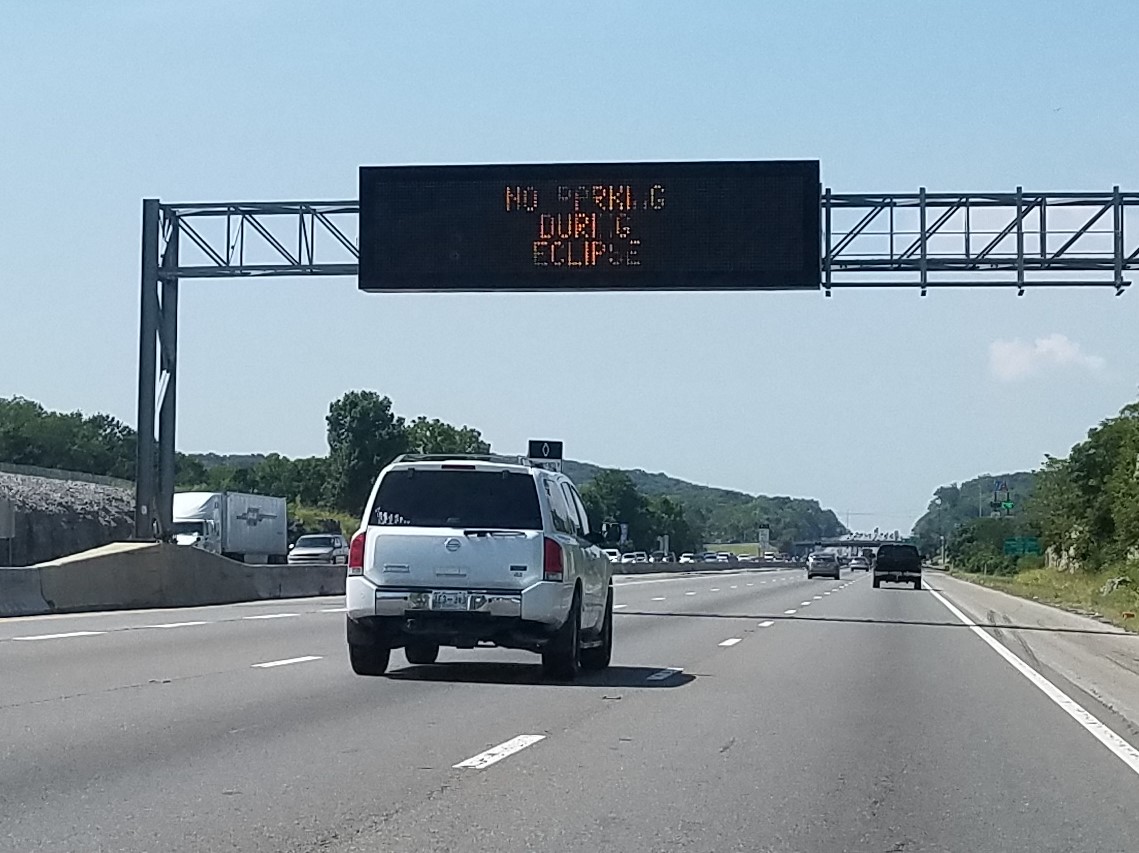
The highways all read "No parking during eclipse"

This morning we stopped at Wal-Mart for chairs, umbrellas, and snacks, then drove to Stones River National Battlefield. As we reached the park, the rangers directed us to a special entrance for the event and they gave us glasses, brochures about the special events and the park unigrid.
Line to get into Stones River NB

We parked and found a shady spot to settle down and wait for the eclipse to start. There was already a big crowd by 9:30 and throughout the morning, more people arrived.


We toured the visitor's center and some of the grounds. The National Park Service had a special stamp made up for the occasion!
Partial eclipse 1
Partial eclipse 2


Almost full eclipse 3
Corona in full eclipse 4


Sun peeking out after full eclipse
The eclipse started at noon and it was fun to chat with other people while we checked the progress of the moon. At the full eclipse, the sky went dark, except for the horizon far off. People cheered and the stunning corona appeared. It didn't last as long as we had expected. When the corona finished and went back into partial eclipse, most people packed up and left. It was truly an amazing event and we were lucky that the large puffy clouds did not fully obstruct the totality. After the totality, we stayed for a while longer, and drove past the national cemetery on our way back to the Nashville area.

This park commemorates many of the Civil War battles in this area. They had good displays for children along with interactive elements. We're not fans of the war stories, but this park did an effective job of describing life during this period and how the war affected the area.

Thursday, August 4, 2016

Park Unit 81: Cuyahoga Valley National Park

LA to NJ Road Trip: Day 8


8/4/16. This morning we headed out to visit the last park of our road trip: Cuyahoga Valley National Park in Ohio. It was difficult to find the visitor's center at the Hunt House since there are few signs.
Hunt House Visitor's Center
There is also no real entrance to this park, and no fee, which seemed strange until we watched the film that explained the history of the park. It was established in 1978 as a National Recreation Area and later was designated a national park in 2000. There has been a lot of resistance by homeowners and landowners who have not wanted to sell their land to the government to be included in the park. Things are slowly progressing in making this park more like a national park. It still feels like a recreation area with lots of trails for hiking and biking, including the Ohio and Erie canal towpath. The towpath trail follows the historic route of the Ohio & Erie Canal which opened up Ohio to rest of the settled eastern states. It was built between 1825 and 1832, connecting Cleveland on Lake Erie to Portsmouth on the Ohio River.

Views along the Ledges Trail

View from the Ledges Trail Overlook. This is from the top of the large rock walls.
We got good advice from two of the rangers at the Hunt House and spent most of our time at the Ledges which was originally part of the Virginia Kendall Park, a state park that was created in 1921 and includes many infrastructure improvements by the CCC. The Ledges trail was wonderful and really felt like a national park in its scale, it beauty, and the sense of being removed from the real world. The relative quiet was a relief, although it was so different from the western parks that had virtually no sound except the wind. Instead there were the sounds of the woods: cicadas, mosquitoes, crickets, birds, that made it feel alive.


With only a short time to spend in the park, this was a great choice and we highly recommend the Ledges Trail. There are also a lot of historic buildings throughout the park, but it's necessary to have a plan since the park is spread out and interrupted by highways and residential neighborhoods. Hopefully with more funds and good leadership, this park will continue to develop and improve the natural environment in this beautiful valley.


It was very special to be in an eastern park that looks more like home. We tend to think of national parks looking like Yosemite or Yellowstone, so it's great to see that we are also preserving and protecting the beautiful areas of the east.

Wednesday, August 3, 2016

Park Units 79 & 80: Pullman National Monument and Indiana Dunes National Lakeshore (National Park)

LA to NJ Road Trip: Day 7

8/3/16. Our first stop today was at Pullman National Monument just south of Chicago. This historical district was just made into a national monument last year (thanks, Obama!). It was the first model, planned industrial community for the Pullman Company which made Pullman train cars. It was the scene of the violent 1984 Pullman strike which led to the creation of Labor Day as a federal holiday. 


We had a wonderful history lesson, brought to life on a walking tour of the town which still has many of the original buildings. Our tour had an interesting group of people, including a woman who just wrote a book about being the first African-American airline flight attendant, and two young girls who were riding bikes in town and decided to join our tour. Interestingly, they lived in Pullman but had no idea of the town's history. I hope the park does more outreach to schools! 

It was a fascinating tour and we learned a great deal. I highly recommend this park unit, especially as they improve and add onto the tour and grounds with the support of the National Park Service now.

Next we drove to Indiana Dunes National Lakeshore. We arrived early afternoon and explored the educational center and went to one of the many beaches surrounded by the very high dunes. Lake Michigan is immense. We could see nothing but water all the way to the horizon.


It was very interesting to compare this lake ecosystem to the barrier island ecosystem that we are more familiar with. The nice thing was that the lake was being used by many families. What a great use of taxpayer money!


We left late in the afternoon for a 5 hour drive to Ohio. We can tell we're closer to home since the landscape looks so familiar and the traffic is getting very heavy! Looking forward to the last day of our trip tomorrow.